Showing posts with label St Georges. Show all posts

Wednesday, 22 October 2014

The Scene of Crime House - Kingston


The Scene of the crime
Between sketching musicians in late night haunts I enjoy stepping into the daylight occasionally. Earlier this month (13/10/2014) I was invited into a Scene of Crime House in Kingston to see what goes on in a property with such a macabre title. Despite looking like any other semi-detached house this one contains various types of mock crime scenes, including burglary, arson, assault and sexual crime. Students have to pick up evidence carefully and transport it back to the labs for preservation and analysis. After only 2 weeks of lectures in this academic year , it was time for the Kingston University MSc Forensic Analysis students to put some of their theories into practice.
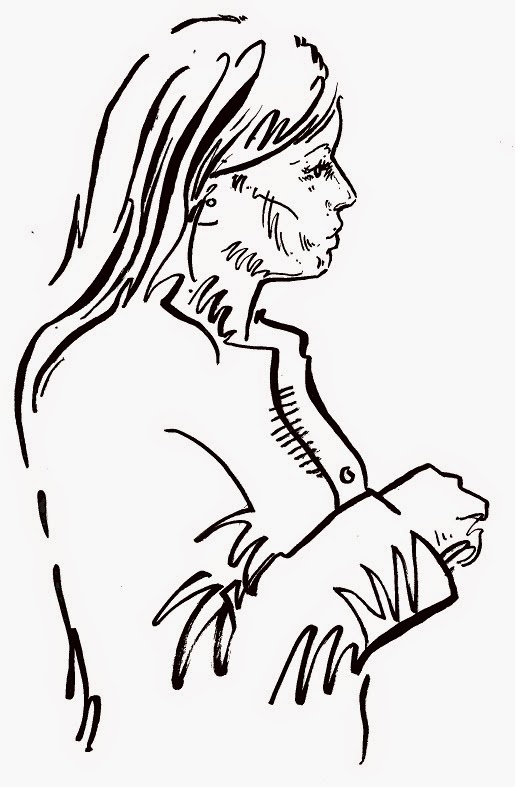

Dr. Baljit Ghatora
I was going in blind to this situation. My imagination was a fertile ground for all kinds of brutal scenarios. The students beside me transformed themselves into white clad investigators. All personal fashion hidden under these clinical bodysuits. As a group they looked like a group of snowmen who had just completed a particularly successful slimming regime.
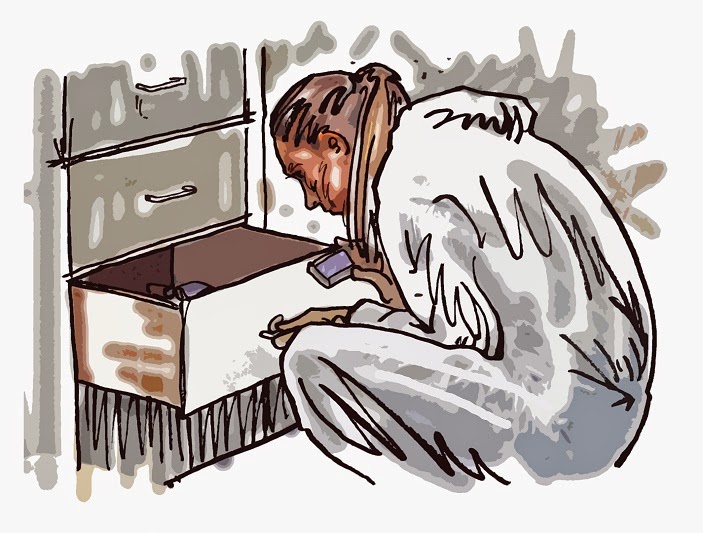

Denise
After a pep talk from tutor, Dr. Baljit Ghatora, the group leader Mitchell opens the door of the kitchen and enters alone. The rest of us stand outside. What will he find inside? We shift nervously from foot to foot, although it might be the chill in the house that keeps us moving.

All is quiet. We stare at the white kitchen door. Everything is a blank except our minds.

Documentation and Communication are the key to gathering all the information at this crime scene. Hopefully we'll avoid any unexpected surprises too. As Mitchell walks out he tells us, "There are signs of a struggle".
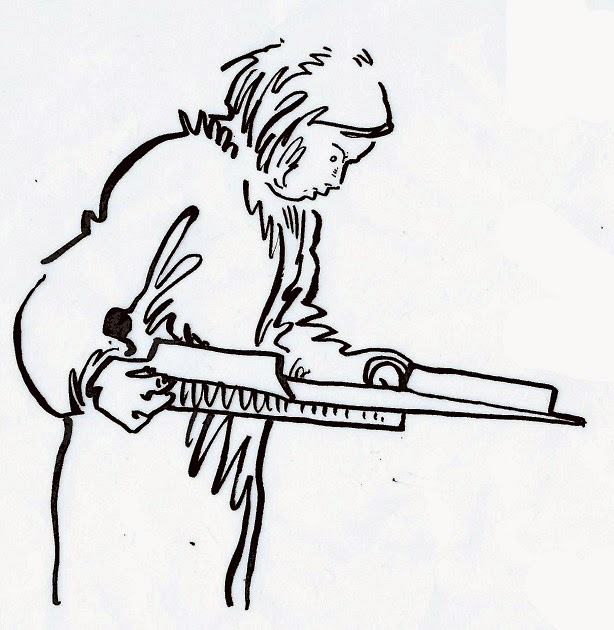
Regina
As we enter together, the scene before us is surprisingly underwhelming. Yet in the hands of the four members of this Forensic team a story unfolds that is anything but tiresome reading. Small relationships between items and location suggest twists in the narrative. Denise spots fingerprints on the window pane. Someone didn't use the door (which is locked) to get in or out, or both.

Mitchell
There are a number of things that look out of place, a chair knocked to the floor, a length of orange rope that is too small to be of any practical use. Then there are objects that shriek of burgeoning meaning and potential, like a set of knifes. Even more telling is that there is one missing.

As the scene is explored the team analyse what they find and what they think has happened. What appeared at first a largely benign room is now full of possible plots and sub-plots. Analysis though plays a minor role for the next 30 minutes as Denise photographs the room from every angle while Merve and Regina gather evidence.
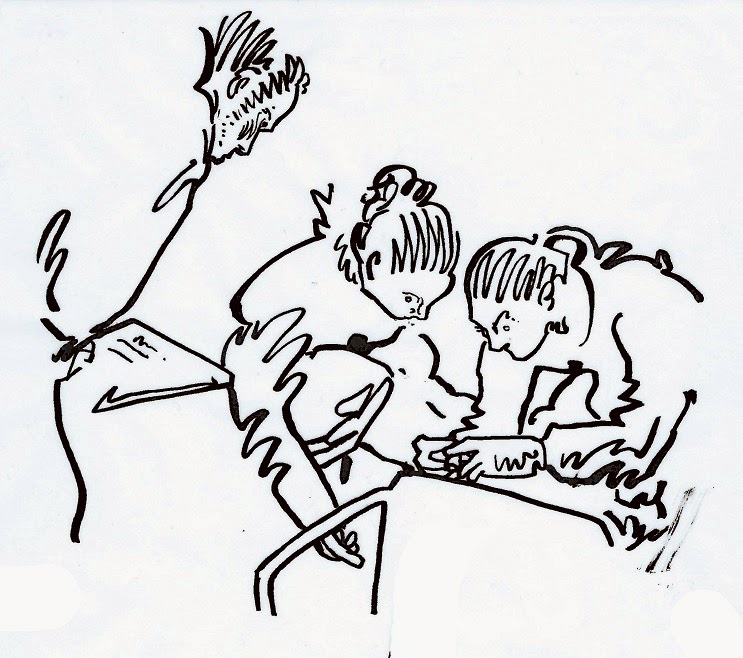
The crime scene team
Tension though hasn't been suppressed totally with all the measuring, bagging and boxing. Another sweep of this crime scene reveals that a door, presumed padlocked, is in fact open. The lock has been tampered with or recently prised apart. We all draw in our breaths as the door is slowly pulled ajar. Fortunately (or possibly unfortunately) a dead body doesn't jump out. There is no ghost train jack-in-the-box to scare us. It must be very rare to find a metaphorical or even literal 'smoking gun' and it was time to return to the documenting of evidence rather than detective work.


Merve
The relationship between the four students came under pressure in this highly technical situation. It was clear that a working and personal relationship would need to develop if this was going to me a successful team in the future.

I'm hoping to return to the scene of the crime to see if this is the case when the delights of 'assault' and 'murder' scenes await me next year. Who knows I might even have a still life to draw. A very still life.

AL.

On November 5th from 5-7pm I will be exhibiting a series of paintings, drawings, sound recordings and films that have been inspired by the Simulated mental health ward at Kingston University and St Georges, University of London.
The 'What's Real is home' exhibition will be at the Scene of Crime House, 14 Fassett Road, Kingston Upon Thames, KT1 2TF


Monday, 24 February 2014

The Corridor - St George's University London

Tadhg Caffrey
Earlier this month I was invited along to St George's University London by Tadhg Caffrey who is the Public Engagement officer on the Tooting campus. Since becoming artist-in-residence on their Simulated Mental Health ward at Kingston I had not visited the Tooting site and imagined it would also yield its stories under a close inspection. Psychotherapist Harvey Wells told me that I should embed myself in the corridor that links the University with its neighbour St George's Hospital and just watch what unfolds.

Tadhg Caffrey is on a mission to engage the public and spread the word wider afield, his raison d'etre is not only to ensure the most appealing and creative side of SGUL's work is accessible to the wider public and specifically our local community but also to do it with a certain joie de vivre.

Waiting to be taken home
Next month he showcases his 'Spotlight on Science' public event on 26th March where Professor Sanjay Sharma and St George's researchers will be discussing sudden death in sport. Although this sounds an emotive subject it was the ideas and ambition that bubbled on Caffrey's back burner that piqued my interest. His idea for a Health Comic Convention is a crackerjack, based around the award winning artist Emily Hayworth Booth. I can see this being a fascinating way to help patients explore the narratives of being ill, in hospital or even as a visitor or carer.


Before I settled down to my sketching I explored the inner sanctum of the University and hospital. In the library the hide of Blossom the cow, draped seductively over a vaulting horse greeted me like an experiment in crossbreeding tannered species. Then down into the dungeon to sweep past the morgue and into the Museum of Pathology, where rows of glass containers trapped their brains, intestines and deformed livers in a wonderland of inspiration for any artist. I was in heaven.

Corridor Life

How I wish I could have sluiced down a tanker's worth of formaldehyde into the corridor that links St George's hospital and the university. It represents the perfect cross section of life in these two
establishments. At the corridor's furthest tip, deep in hospital territory the sun streams in through huge plate glass windows. Patients in wheelchairs sun themselves like lizards, capturing the rays as if they possessed life imbuing powers. A few mobile phone conversations ending in huffy silences and on more than one occasion I watched a telephone listener descend into an unscheduled siesta.
 
Everyone moved at different speeds along the corridor, a granny ambled in her purple velour tracksuit while a patients in blue robe, limped a little quicker, one arm dangling helplessly from under his hoody. Plenty of couples walked arm in arm, it was hard to tell who supported who, emotionally and physically. Two girls defied the hubbub, by using sign language to communicate in their own silent fishbowl world. There were regular visits to the ever cheerful receptionists who wielded their advice from deep within the belly of the corridor. After sitting next to them for 30 minutes you start to notice that their visitors either arrived undressing themselves or dripping long wet trails like slugs on Speed.

There were lulls of course before the lifts spewed out blue gowned troglodytes and I though in those
moments about how you could represent these narratives in one piece of artwork. I've already been working hard to do this since visiting the Simulated Mental Health ward in January, and new works are emerging on a weekly basis. We'll be presenting some of our recent creations at St George's University London on Wednesday 16th April at 6pm as part of the 'Art of Medicine' series of lectures and exhibitions. Please come and join us, it's open to all but you'll need to register before the 10th April. Details at www.sgul.ac.uk/research/public-engagement/

Its with great pleasure that I share the first short film to emerge from the residency, called 'Ping Pong Paranoia' (below). Harvey Wells and I recorded the 'patient's' monologues whilst on the Simulated Mental Health Ward and this has proved to be a springboard for creativity. The voice you hear is of  'Sandra' who is agitated and feels trapped in this ward environment. The excellent score is by Toy Rokit, who we will be collaborating with throughout the year.

Toy Rokit are
Bill Mudge - Keys/FX/Samples/Loops
Mark Rose - Bass/FX/Samples/Loops
Chris Nickolls - Drums/FX/Samples/Loops


At the event on the 16th April we will be screening 'Ping Pong Paranoia' and also our first film with poet Robin Vaughan-Williams.

AL.